
Children's sleeping bag
2 products
Un sac de couchage enfant répond à des besoins spécifiques qu'un modèle adulte ne couvre pas correctement : dimensions adaptées à la morphologie des plus jeunes, isolation calibrée pour un métabolisme plus sensible au froid, et systèmes de fermeture pensés pour une utilisation autonome. Choisir un sac de couchage pour enfant à la bonne taille est aussi important que choisir la bonne température de confort : un enfant dans un sac trop grand conserve mal sa chaleur corporelle et peut passer une nuit difficile même avec un bon garnissage.

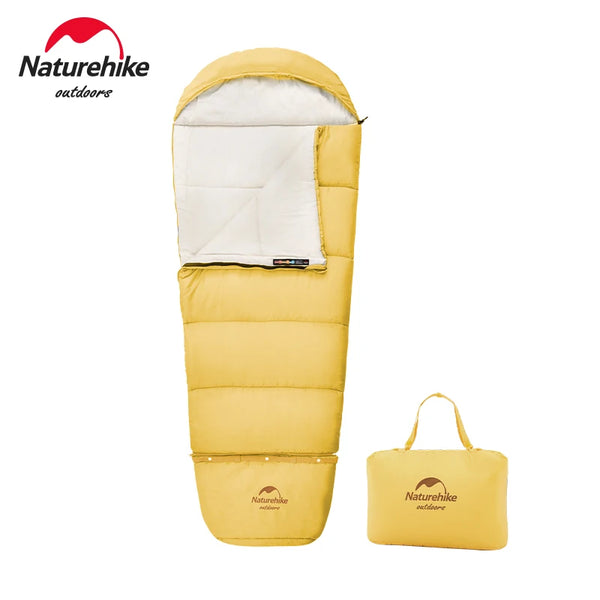
Size and dimensions: the criteria not to be overlooked
A child's sleeping bag must correspond to the child's actual height, with a slight, acceptable margin for growth. A bag that is too long creates excess air volume that the body struggles to heat, which can lead to an uncomfortable night even with high-quality insulation. Interior length and shoulder width are the two measurements to prioritize on every product page. Some models offer length adjustment systems that allow the bag to be adapted to the child's growth over several seasons.
The rectangular shape is often preferable for younger children: it offers more freedom of movement, makes it easier to get in and out of the bag independently, and adapts better to a child's changing sleeping positions. The mummy shape, while more thermally efficient, is better suited for older children and for high-altitude use where thermal performance is paramount.
What comfort temperature for a child's sleeping bag?
Children have a different metabolism than adults: their body surface area-to-volume ratio is higher, which makes them more sensitive to nighttime heat loss. It is advisable to aim for a comfort temperature slightly lower than the forecast minimum temperatures, with a wider margin than for an adult. The values displayed on sleeping bags for children follow the same EN 13537 standard as adult models, but their interpretation must incorporate this increased sensitivity to cold.
- Summer camping in the lowlands (10-15°C at night): a comfort temperature of +5°C is a reasonable benchmark
- Spring or autumn camping: aim for 0°C to +5°C depending on altitude and forecast conditions
- Nights in mountain huts or at altitude: plan for an extra margin: children who get cold easily may need a warmer bag than the temperature rating suggests
- Children who get cold easily or are very young: always choose a more conservative thermal range, even if it means venting the bag during milder nights
Insulation and maintenance: priorities for a junior sleeping bag
For regular camping use with children, synthetic insulation offers real practical advantages: it is less sensitive to moisture, tolerates frequent washing better, and dries faster—three precious qualities when dealing with inevitable spills and nighttime perspiration. A synthetic junior sleeping bag is often easier to maintain on a daily basis, and its price-to-durability ratio is consistent with intensive use by young children.
Natural warm down insulation remains relevant for older children who are autonomous with their equipment, in the context of high-altitude bivouacking where weight and compressibility start to matter. A lightweight, warm down sleeping bag then represents a long-term investment that can accompany the child into adulthood if the size allows.
Child's sleeping bag and family outings
Choosing a child's sleeping bag often takes place in the context of a family outing where overall logistics matter as much as individual performance. A lightweight bag that is easy to transport and simple to use independently makes camping nights easier for the whole family. The ease of the zipper, the presence of an interior pocket to store a headlamp or a book, and the possibility of personalizing the bag with a sleeping bag liner are details that significantly improve the experience for the youngest ones.
For outings where adults and children share the same sleeping space, the double sleeping bag collection offers models adapted for duos. For camping stays where comfort takes priority over weight, the camping duvet collection brings together bags designed for accessible family use.