


Sac de couchage duvet 5 degrés pour le trekking

Duvet de canard 650 cuin réparti en ratio 2:1

Sac de couchage leger et compact pour la randonnée

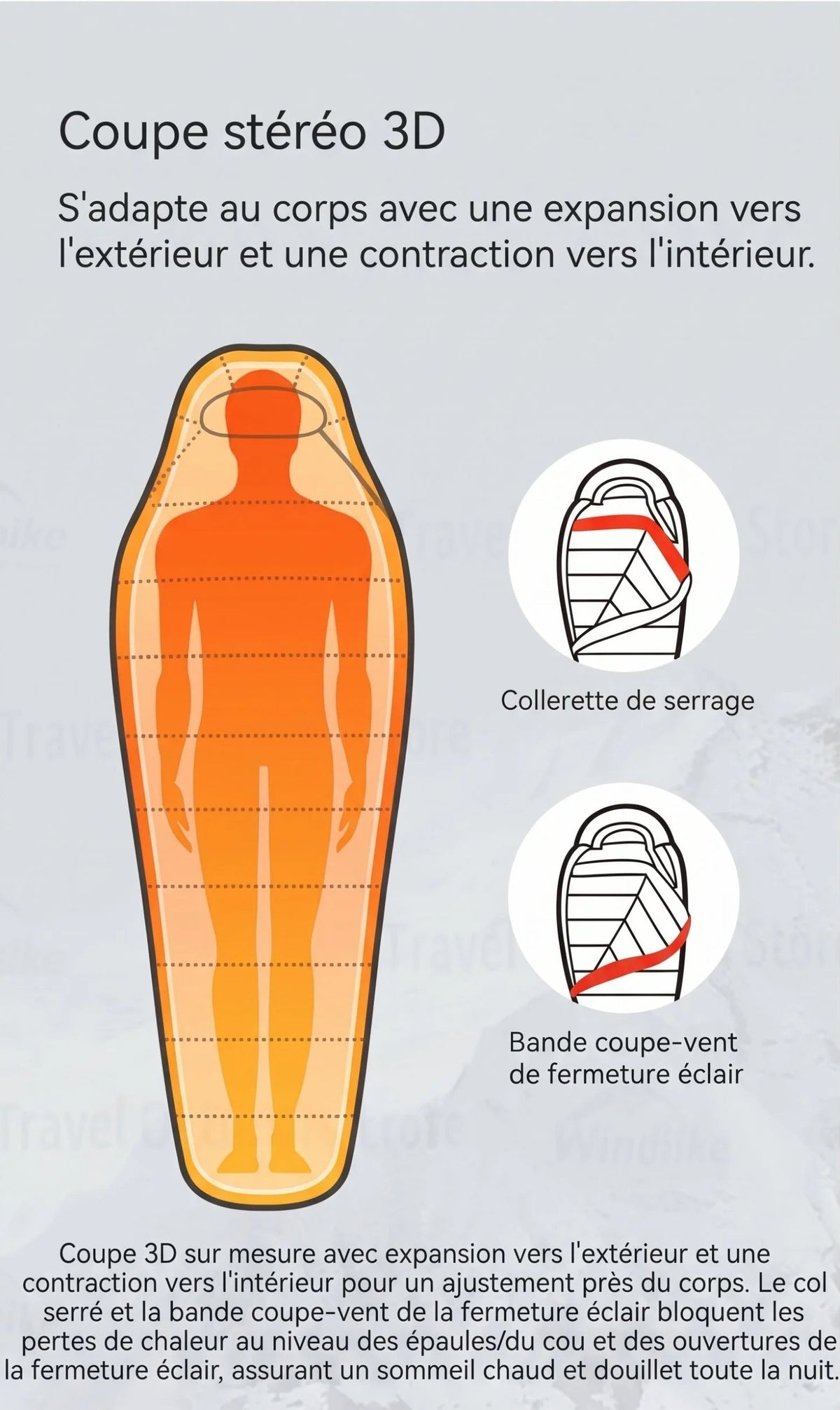
Col resserrable et coupe 3D contre les pertes de chaleur




Doubt about which bag is right for you?
The field guide helps you choose based on skill level, temperature, needs, and weight. Support answers specific questions.
Find my bag Contact supportFrequently Asked Questions
The Naturehike AIR300 has a comfort temperature of 4°C and a lower limit temperature of -1°C, measured to the ISO 23537 / GB/T 38426-2019 standard. These values apply under standard conditions: sleeper in thermal base layers, on an insulated sleeping mat. It is designed for trekking, randonnée, bivouac use (Printemps / Automne).
The Naturehike AIR300 is filled with Duvet de canard 90 %, 650 cuin, hydrofuge, 260/280/300 g (S/M/L). Down offers the best warmth-to-weight ratio: it packs down small and weighs less than synthetic insulation of equivalent warmth, which makes it the natural choice for wild camping and multi-day trekking. On the other hand, it loses efficiency when damp and needs careful drying. The Naturehike AIR300 weighs 600 g, which places it in the ultralight category.
A 3-season sleeping bag is designed for spring, summer and autumn. Its comfort temperature sits between 0°C and +5°C, which covers most wild camps in France up to 2,500 m outside winter conditions. In winter or above 2,500 m, a dedicated cold-weather bag is needed.
A 3-season bag is suited to night-time temperatures between roughly 0°C and +15°C. Below 0°C, thermal comfort is no longer assured without extra equipment (liner, additional sleepwear). Above +15°C, most sleepers will find the bag too warm: venting through the foot zip helps regulate.
For the vast majority of walkers and trekkers in France (GR20, GR5, Tour du Mont Blanc from June to September), a 3-season bag with a 0°C comfort rating is sufficient. A 4-season bag is only needed above 3,000 m outside summer, in winter conditions, or for exposed high-altitude wild camps in autumn.