


3-season sleeping gear focused on compactness and lightweight.
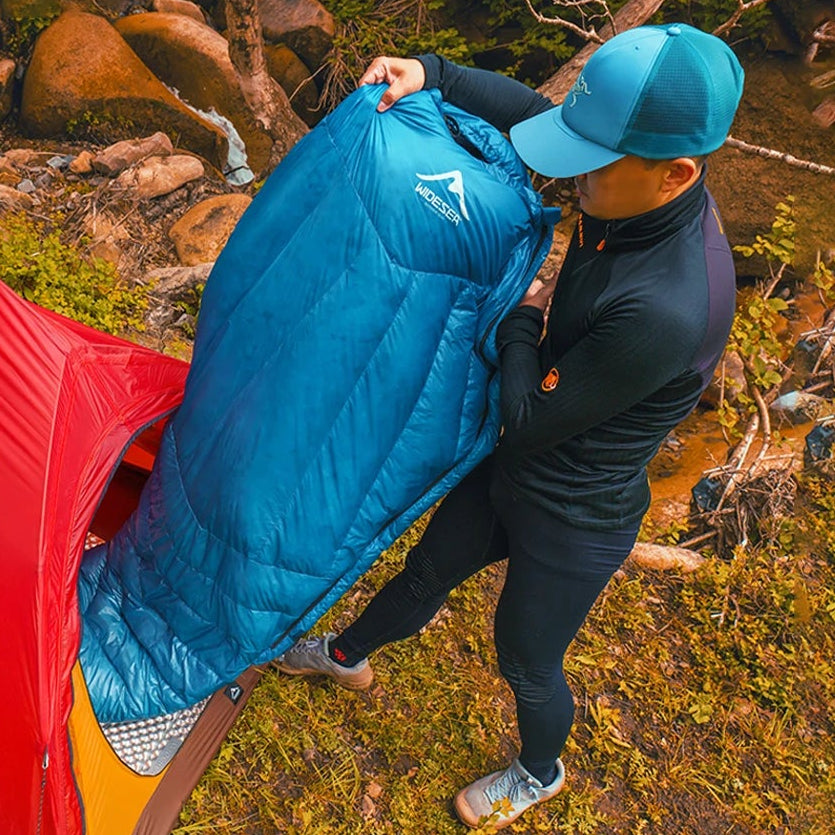
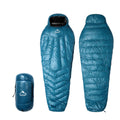
The Widesea DS13 5-degree sleeping bag is designed for hikers who want to travel light but need reliable thermal insulation for mid-season nights. Weighing in at around 700 grams, it helps keep your backpack agile and balanced. Its contoured shape reduces empty space inside the bag, which speeds up the warming process generated by your body heat from the first few minutes of rest.

Insulation-to-weight ratio and water-repellent protection
The use of natural 800 FP (Fill Power) down insulation ensures excellent loft while offering impressive compressibility when packing up camp in the morning. The 15D nylon outer shell is treated to resist overnight condensation. It is a lightweight sleeping bag that provides peace of mind for regular trekking.
If you are instead planning on static camping trips where weight is not an issue and you prefer synthetic insulation that is moisture-resistant, the Naturehike MJ300 will be a perfectly suitable alternative.



Doubt about which bag is right for you?
The field guide helps you choose based on skill level, temperature, needs, and weight. Support answers specific questions.
Find my bag Contact supportFrequently Asked Questions
The Widesea DS13 has a comfort temperature of 5°C and a lower limit temperature of 0°C. These values apply under standard conditions: sleeper in thermal base layers, on an insulated sleeping mat. It is designed for hiking, bivouacking use (3 seasons).
The Widesea DS13 is filled with 800 cuin. The Widesea DS13 weighs 720 g, which places it in the ultralight category.
A 3-season sleeping bag is designed for spring, summer and autumn. Its comfort temperature sits between 0°C and +5°C, which covers most wild camps in France up to 2,500 m outside winter conditions. In winter or above 2,500 m, a dedicated cold-weather bag is needed.
A 3-season bag is suited to night-time temperatures between roughly 0°C and +15°C. Below 0°C, thermal comfort is no longer assured without extra equipment (liner, additional sleepwear). Above +15°C, most sleepers will find the bag too warm: venting through the foot zip helps regulate.
For the vast majority of walkers and trekkers in France (GR20, GR5, Tour du Mont Blanc from June to September), a 3-season bag with a 0°C comfort rating is sufficient. A 4-season bag is only needed above 3,000 m outside summer, in winter conditions, or for exposed high-altitude wild camps in autumn.