


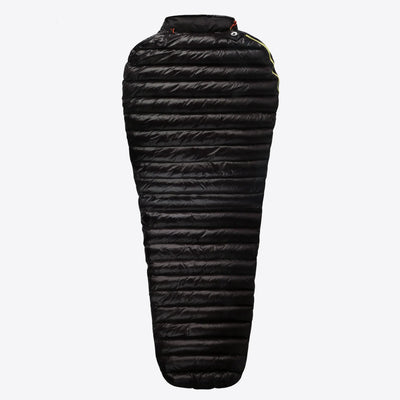
440 g without hood: a commitment to the ultralight approach
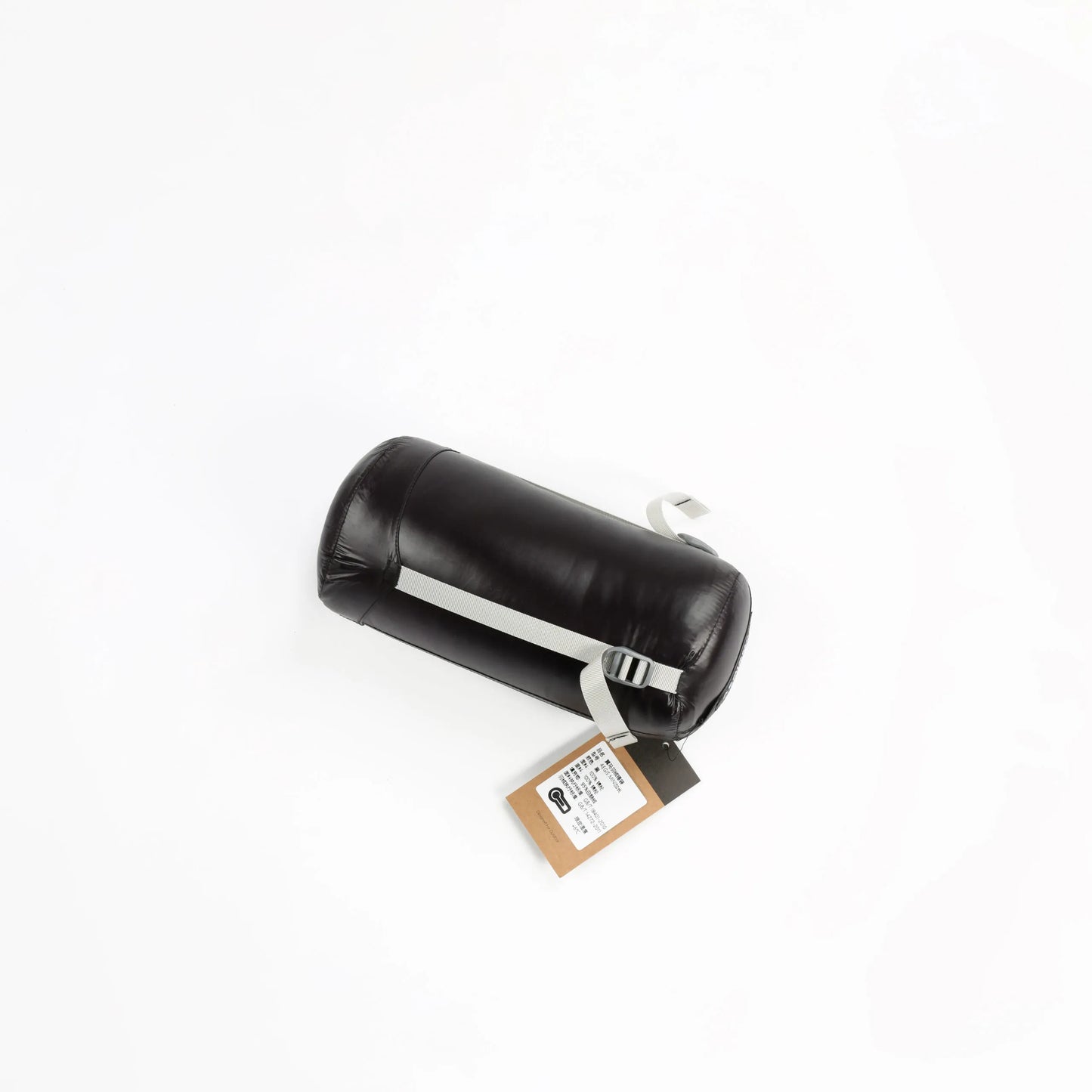
At 440g in Regular, the Aegismax MINI ultra-light sleeping bag is one of the few ultra-light sleeping bags under 500g featuring 800-fill-power certified white goose down insulation. The lack of a hood is a deliberate design choice: removing the dead volume of a hood reduces weight and bulk without compromising insulation for the torso and limbs. Compressed to 20x12 cm, it fits into a backpack or bike bag pocket without taking up useful space. For sleepers who naturally wear a sleeping cap or neck gaiter, the lack of a hood is not a drawback but a clear weight saving.

Comfort +11°C EN 13537: summer temperature range verified
The EN 13537 temperature range certifies a comfort rating of +11°C and a limit of +6°C for a 440 g trekking sleeping bag. These values correspond to nights in late spring, summer in the lowlands, and early autumn below 1000 m altitude. In humid conditions or with a low R-value sleeping pad, the perceived temperature shifts towards the cold. The extreme of -9°C is a theoretical survival threshold, not a target usage. For a 10-degree sleeping bag used in dry summer bivouacs with an insulating inflatable mattress, the MINI covers the majority of nights during the warm season without extra weight.
800-fill goose down and 20D DWR nylon: optimized warmth-to-weight ratio
The 20D iFlex® DWR nylon outer fabric manages light condensation and morning dew without saturating the insulation, a critical point for an ultralight down sleeping bag whose shell is thin by design. The 800-fill power white goose down insulation offers high loft relative to its mass: at 440 g, the MINI insulates as effectively as a synthetic bag twice as heavy at an equivalent temperature. For a summer trekking sleeping bag on routes where the daily carry exceeds 15 km, this weight-to-warmth ratio is the primary argument for its choice.

20 x 12 cm compressed: the benchmark for compactness in a bivouac sleeping bag
Compressed to 20 x 12 cm, the MINI reaches a pack size comparable to a 500 ml water bottle. For an ultra-compact bivouac sleeping bag, it is a benchmark difficult to achieve with natural down filling at this level of thermal range (+11°C EN 13537 comfort rating). The Long version (560 g) is suitable for body types up to 195 cm without compressing the feet. For an ultra-light trekking sleeping bag on lightweight hiking or cycle touring routes, this format allows for 20 to 25 L backpacks without compromising the space dedicated to technical equipment.
If you want to test the quilt format around 10°C with an even smaller packed size, the Naturehike Cicada drops to 385g in size M — 750FP RDS-certified goose down.


Why pay more for the same performance?
The Aegismax MINI was compared with the Millet Light Down 11°. The finding is simple: you get equivalent technical features and warmth without paying the brand premium. Keep your budget for your next expedition.

Data checked against the brands' official product pages — subject to change.

Doubt about which bag is right for you?
The field guide helps you choose based on skill level, temperature, needs, and weight. Support answers specific questions.
Find my bag Contact supportFrequently Asked Questions
The Aegismax MINI has a comfort temperature of 11°C and a lower limit temperature of 6°C, measured to the EN 13537 standard. These values apply under standard conditions: sleeper in thermal base layers, on an insulated sleeping mat. It is designed for hiking, trekking use (Summer).
The Aegismax MINI is filled with 800 cuin. The Aegismax MINI weighs 440 g, which places it in the ultralight category.
A 3-season sleeping bag is designed for spring, summer and autumn. Its comfort temperature sits between 0°C and +5°C, which covers most wild camps in France up to 2,500 m outside winter conditions. In winter or above 2,500 m, a dedicated cold-weather bag is needed.
A 3-season bag is suited to night-time temperatures between roughly 0°C and +15°C. Below 0°C, thermal comfort is no longer assured without extra equipment (liner, additional sleepwear). Above +15°C, most sleepers will find the bag too warm: venting through the foot zip helps regulate.
For the vast majority of walkers and trekkers in France (GR20, GR5, Tour du Mont Blanc from June to September), a 3-season bag with a 0°C comfort rating is sufficient. A 4-season bag is only needed above 3,000 m outside summer, in winter conditions, or for exposed high-altitude wild camps in autumn.