

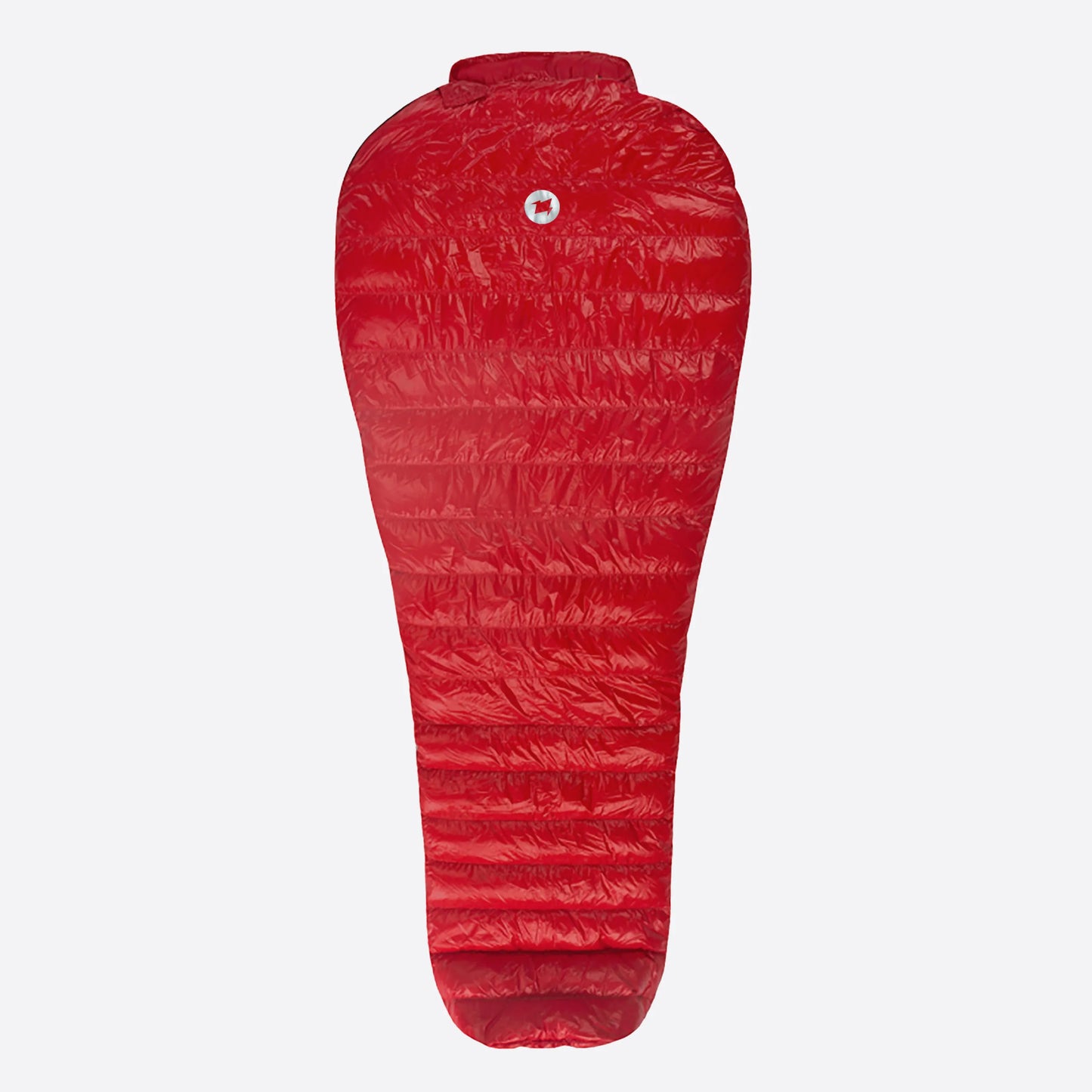
10-degree down sleeping bag: 506 g for sleeping outdoors in summer without weighing down your backpack
Five days of hiking in July, and a 1.5 kg "three-season" sleeping bag that takes up 20 L for nights that don't require so much. The Aegismax Nano is a 10-degree sleeping bag with 506 g of down in Regular, designed for sleeping outdoors in summer without weighing down the backpack. Its 10 °C comfort rating is a laboratory value, with an insulating mat: the 5 °C limit temperature offers a reserve if the night is cooler than expected. For lower comfort, the Aegismax Nano 2 (5 °C comfort) is worth comparing.
Ultra Dry 700 Cuin Goose Down: loft without the weight, with moisture in mind
When every gram counts, weight savings start with the fill. The Nano features 250 g of 700-fill-power white goose down in Regular (280 g in Lengthen), RDS-certified and treated with an Ultra Dry water-repellent finish, for a high warmth-to-weight ratio and good compressibility. For an ultralight sleeping bag, the zoned construction avoids adding material where it isn't needed. One limitation to keep in mind: a water-repellent treatment is not waterproof. Dew, condensation under a tarp, and damp nights require a ventilated shelter, and wet down provides much less insulation.
No hood, with a high collar and double drawcord: the mummy fit and its limits
There is no hood, which saves a few grams, but your head remains exposed when the night air cools: a beanie completes the setup. The mummy cut close to the body improves thermal efficiency, and the neck gaiter with an adjustable double elastic cord limits drafts. For the feet, the 3D footbox follows the natural position of the foot, and the self-sealing vent allows you to cool down without opening the entire bag. The YKK#5 two-way zipper adjusts the ventilation according to the temperature of the night.
Ultra-compact sleeping bag measuring 13 × 22 cm: ultralight without the dreaded fragility
The classic fear: an ultralight that tears on the second night. The ultra-compact sleeping bag packs down to 13 × 22 cm in both Regular and Lengthen, with an ultralight compression sack and a mesh stuff sack for storage. The DWR-treated iFlex 20D ripstop outer and iFlex 20D SoftTouch liner remain durable for their weight, but are thin: it is best to avoid abrasive surfaces. Regular and Lengthen from the same series can be zipped together.
The redesigned version of the Nano — 800FP fill, box baffles, 5°C comfort range — is the Aegismax Nano 2, at 624 g for the Regular size.
Why pay more for the same performance?
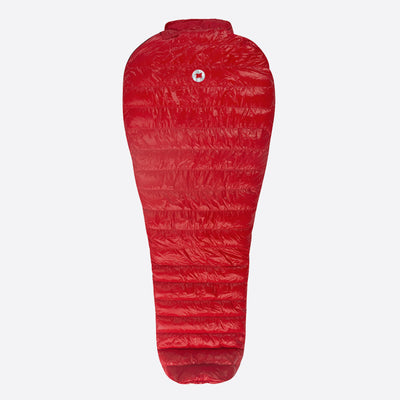
The Aegismax Nano was compared with the Millet Light Down 11°. The finding is simple: you get equivalent technical features and warmth without paying the brand premium. Keep your budget for your next expedition.

Data checked against the brands' official product pages — subject to change.

Doubt about which bag is right for you?
The field guide helps you choose based on skill level, temperature, needs, and weight. Support answers specific questions.
Find my bag Contact supportFrequently Asked Questions
The Aegismax Nano has a comfort temperature of 10°C and a lower limit temperature of 5°C, measured to the EN 13537 standard. These values apply under standard conditions: sleeper in thermal base layers, on an insulated sleeping mat. It is designed for hiking, trekking use (3 seasons).
The Aegismax Nano is filled with Ultra Dry 700 cuin white goose down, RDS certified (250 g in Regular). Down offers the best warmth-to-weight ratio: it packs down small and weighs less than synthetic insulation of equivalent warmth, which makes it the natural choice for wild camping and multi-day trekking. On the other hand, it loses efficiency when damp and needs careful drying. Stated fill power: 700 cuin (the higher the value, the more the down insulates for a given weight). The Aegismax Nano weighs 506 g, which places it in the ultralight category.
A 3-season sleeping bag is designed for spring, summer and autumn. Its comfort temperature sits between 0°C and +5°C, which covers most wild camps in France up to 2,500 m outside winter conditions. In winter or above 2,500 m, a dedicated cold-weather bag is needed.
A 3-season bag is suited to night-time temperatures between roughly 0°C and +15°C. Below 0°C, thermal comfort is no longer assured without extra equipment (liner, additional sleepwear). Above +15°C, most sleepers will find the bag too warm: venting through the foot zip helps regulate.
For the vast majority of walkers and trekkers in France (GR20, GR5, Tour du Mont Blanc from June to September), a 3-season bag with a 0°C comfort rating is sufficient. A 4-season bag is only needed above 3,000 m outside summer, in winter conditions, or for exposed high-altitude wild camps in autumn.