

Massive thermal barrier for moderate winter roaming
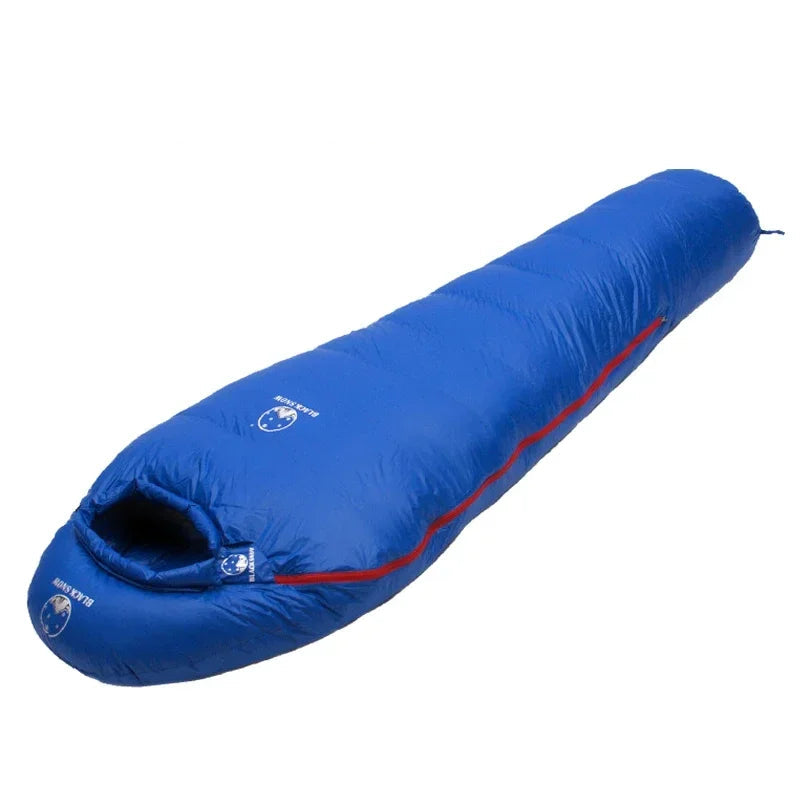
The Black Snow -5°C down sleeping bag is designed for users who prioritize cold-weather protection through high insulation volume. It features 1,000 g of goose down for substantial warmth. It minimizes heat loss as soon as the zipper is closed, a useful feature after a day of exertion in the cold.
Resilience of the nib and protection of the extremities
The 800 cuin goose down retains its loft when repeatedly stored in its compression sack. The enlarged footbox is specifically designed to prevent your feet from stretching the fabric, which would crush the down and reduce insulation. The 400T nylon fabric acts as a windbreak. It is designed for those venturing into mid-altitude winter environments.
Resistance to compression: a down designed to last
800-fill power goose down maintains its loft after repeated cycles of compression and decompression, an important criterion for a cold-weather sleeping bag that will be packed and unpacked daily over several days of trekking.
Enlarged footbox: protecting insulation at the extremities
The enlarged footbox prevents feet from stretching the fabric and compressing the down in specific areas, a relevant point of concern for any extreme cold weather sleeping bag where the slightest compressed zone loses most of its insulating power.
If your mountaineering requires pushing certified insulation down to -10°C with cross-channel baffle construction to stabilize the down in extreme conditions, the technical profile of the Aegismax Ultra Future II is an option worth considering.

Doubt about which bag is right for you?
The field guide helps you choose based on skill level, temperature, needs, and weight. Support answers specific questions.
Find my bag Contact supportFrequently Asked Questions
The Blacksnow has a comfort temperature of -5°C and a lower limit temperature of -10°C. These values apply under standard conditions: sleeper in thermal base layers, on an insulated sleeping mat. It is designed for hiking, bivouacking use (3-4 seasons).
The Blacksnow is filled with 800 cuin. The Blacksnow weighs 1450 g, which places it in the standard category.
A down sleeping bag is insulated with goose or duck down and feathers, whereas a synthetic bag uses polyester fibres. Down offers a better warmth-to-weight ratio and packs smaller than synthetic insulation of equivalent warmth; synthetic keeps more of its insulation when damp.
A well-maintained down sleeping bag retains 80 to 90% of its insulating properties after 5 to 10 years of regular use. The main cause of degradation is long-term compressed storage, which gradually breaks the down clusters. Washing once a year with a down-specific detergent and storing the bag uncompressed out of season significantly extend the life of the fill.
The ideal comfort rating depends on intended use. For summer trekking in France (Alps, Pyrenees, GR20), a comfort temperature between 0°C and +3°C covers almost all situations. For static summer camping in the lowlands, +5°C to +10°C is enough. For extreme cold or winter wild camping in the mountains, aim for -10°C comfort minimum. The comfort temperature is always measured to EN 13537 / ISO 23537-1 / GB/T 38426.