


Winter sleeping bag: -17°C comfort rating in duck down, for cold nights without expeditions
First winter bivouac trip, with overnight temperatures forecast at -8°C in the Vercors or the Pyrenees: a three-season sleeping bag pushed to its limit results in hours of sleeplessness. The Aegismax D5 is a winter sleeping bag with a classic mummy shape, filled with 600 cuin white duck down and rated for -17°C comfort. Laboratory rating, with an insulated sleeping pad: the -25°C lower limit provides a safety margin if the night is colder than expected. Weight: 1,768 g in Regular.

Collar, two-cord hood and two-way zip: where the cold seeps in
At -10°C, the cold creeps in through the neck and along the zip long before penetrating the padding. The windproof collar with two elastic cords seals the opening around the shoulders, the hood is adjusted by two adjustable cords, and a draft-proof baffle doubles the closure with two YKK 5 sliders, which glide without snagging the fabric. The trapezoidal footbox allows the toes to move without compressing the down.

Full-length and 3D side baffles: keep the down in place
Down that migrates leaves empty, and therefore cold, areas, often at the shoulders or hips. The fill is distributed in baffles along the entire length with glued mesh walls that retain the down, complemented by side baffles and three-dimensional side panels (fabric and lining of different cuts). The 15D iFlex® nylon ripstop shell, with a durable water repellent (DWR) finish, is down-proof. The treatment repels light moisture; it does not make the sleeping bag waterproof: damp down insulates less effectively.

Regular for 178 cm, Long for 190 cm: choose your size before your bag
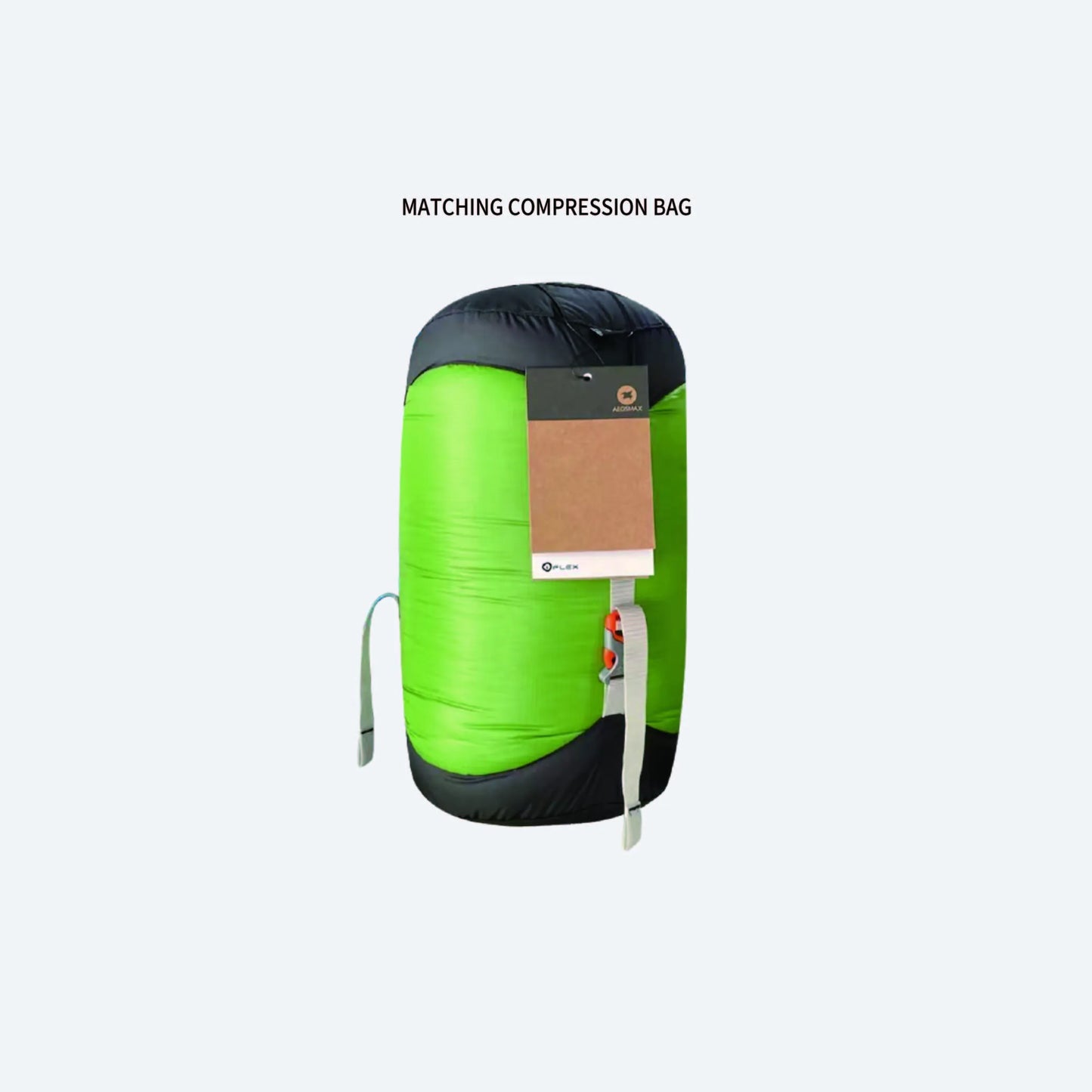
A sleeping bag that is too short compresses the down at the feet, while one that is too long leaves excess volume to be warmed. The Regular (196 × 78 cm, 1,768 g) is suitable for heights up to 178 cm, and the Long (216 × 82 cm, 1,878 g) for heights up to 190 cm; packed, it measures 23 × 38 cm. It features a YKK 5 zipper, Duraflex buckles, and PAIHO hook-and-loop fasteners that prevent snagging and protect the fabric. A medium-sized zippered inner pocket holds small items, and a compression sack and mesh storage bag are included.
For a lower comfort rating or higher loft, compare the Aegismax G5 (comfort -23°C, 800 cuin goose down, 1,768 g in Regular).



Doubt about which bag is right for you?
The field guide helps you choose based on skill level, temperature, needs, and weight. Support answers specific questions.
Find my bag Contact supportFrequently Asked Questions
The Aegismax D5 has a comfort temperature of -17°C and a lower limit temperature of -25°C, measured to the EN 13537 standard. These values apply under standard conditions: sleeper in thermal base layers, on an insulated sleeping mat. It is designed for Mountaineering, expedition use (4 seasons / Extreme cold).
The Aegismax D5 is filled with 90% white duck down, 600 fill power, RDS certified (1,426 g in Regular, 1,500 g in Long). Down offers the best warmth-to-weight ratio: it packs down small and weighs less than synthetic insulation of equivalent warmth, which makes it the natural choice for wild camping and multi-day trekking. On the other hand, it loses efficiency when damp and needs careful drying. The Aegismax D5 weighs 1768 g, which places it in the standard category.
Yes, provided they are used within their real temperature range. A cold-weather bag is designed to keep the sleeper warm below -10°C, but its effectiveness also depends on the insulated sleeping mat (R-value 4 minimum), the clothes worn at night and ambient humidity. The bag alone does not guarantee comfort: it is the complete sleep system that counts.
Several factors determine real thermal comfort: using a sleeping mat with a suitable R-value (R4 minimum for extreme cold), wearing thermal base layers and dry socks, eating enough before sleeping to fuel body-heat production, and making sure the bag is completely dry. A damp bag loses a significant part of its insulating properties, especially down.
The lower limit temperature is the lowest temperature at which a reference man can maintain his body heat curled up, according to EN 13537 / ISO 23537-1. It usually sits a few degrees below the comfort temperature, and the gap varies between models: check the figure on each product page. Below this threshold, comfort is no longer assured — the comfort temperature remains the main selection criterion.