


Extreme cold sleeping bag, laboratory certified to -21.4°C
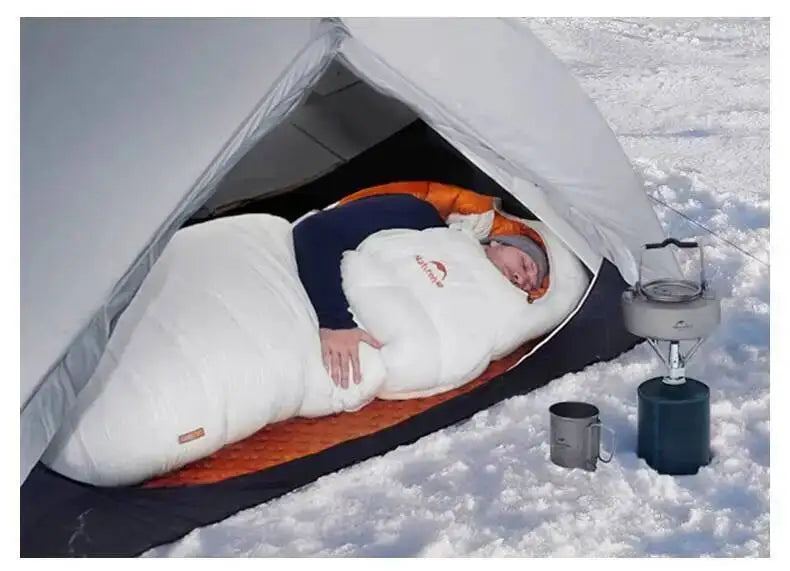
The thermal range of the extreme cold sleeping bag UL1100 is obtained according to GB/T 38426-2019 and ISO 23537 using an instrumented thermal mannequin in controlled conditions (report ZINK-LAB2410037). The comfort rating of -21.4°C corresponds to a standard user sleeping in a relaxed position. The limit rating of -31.0°C is the threshold for male equilibrium in a curled-up position. The extreme rating of -58.7°C is a theoretical survival threshold reserved for emergencies. For any extreme cold sleeping bag, a high R-value sleeping pad is imperative: heat loss through the ground is a critical variable that the bag alone cannot compensate for.

850 FP extreme cold down, 95% down, RDS certified
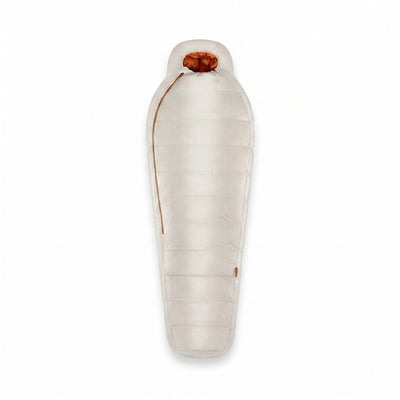
With 1005g of 850 FP white goose down, 95% down content and a certified cleanliness of 1000mm, the UL1100 is a high-performance cold-weather sleeping bag with dense filling for nights below -15°C. Independent laboratory testing confirms a loftiness of 865 in³ (IDFL report #25-800083). The RDS certification guarantees the traceability of the down from farm to processing. Compared to synthetic-fill winter sleeping bags, an 850 FP offers a better insulation-to-weight ratio at equivalent temperatures, with superior compressibility.

Triangular construction and side wall for winter bivouac
The triangular baffle geometry keeps each down chamber at an independent volume, reducing the contact surface between chambers and limiting cold spots at the seams. With an equivalent fill, this process achieves the performance of a 1300g square-baffle bag with only 1100g. The channels, fully closed at both ends, prevent down migration over time. The thermal side wall, exclusive to the 1100g version, insulates the sides of the winter sleeping bag, a critical area for heat loss during prolonged bivouacs at altitude.

Ultra-lightweight extreme cold sleeping bag: 1.59 kg with 1005g of 850 FP down
At 1.59kg in size M with 1005g of 850 FP white goose down, the UL1100 places this ultralight extreme cold sleeping bag in a weight category rarely seen at this level of certified insulation. The 10D 500T nylon outer shell and 10D 500T lining limit the weight of the envelope without compromising resistance to down leakage. Three storage systems are provided: a mesh bag (for long-term storage), a standard stuff sack, and an extreme compression sack (24x25cm) for carrying during alpine approaches with a smaller-capacity backpack.
If down maintenance is a constraint and you are looking for a synthetic winter bag around -7°C, the Naturehike MG360 is the ISO 23537-certified alternative without a specific drying protocol.


Why pay more for the same performance?
The Naturehike UL1100 was compared with the Millet Trilogy. The finding is simple: you get equivalent technical features and warmth without paying the brand premium. Keep your budget for your next expedition.

Data checked against the brands' official product pages — subject to change.

Doubt about which bag is right for you?
The field guide helps you choose based on skill level, temperature, needs, and weight. Support answers specific questions.
Find my bag Contact supportFrequently Asked Questions
The Naturehike UL1100 has a comfort temperature of -21.4°C and a lower limit temperature of -31°C, measured to the GB/T 38426-2019 / ISO 23537 standard. These values apply under standard conditions: sleeper in thermal base layers, on an insulated sleeping mat. It is designed for mountaineering, winter bivouac, extreme cold trekking, expedition use (4 seasons / extreme cold).
The Naturehike UL1100 is filled with 850 fill power white goose down, 95% down, RDS certified. Down offers the best warmth-to-weight ratio: it packs down small and weighs less than synthetic insulation of equivalent warmth, which makes it the natural choice for wild camping and multi-day trekking. On the other hand, it loses efficiency when damp and needs careful drying. The Naturehike UL1100 weighs 1590 g, which places it in the standard category.
Yes, provided they are used within their real temperature range. A cold-weather bag is designed to keep the sleeper warm below -10°C, but its effectiveness also depends on the insulated sleeping mat (R-value 4 minimum), the clothes worn at night and ambient humidity. The bag alone does not guarantee comfort: it is the complete sleep system that counts.
Several factors determine real thermal comfort: using a sleeping mat with a suitable R-value (R4 minimum for extreme cold), wearing thermal base layers and dry socks, eating enough before sleeping to fuel body-heat production, and making sure the bag is completely dry. A damp bag loses a significant part of its insulating properties, especially down.
The lower limit temperature is the lowest temperature at which a reference man can maintain his body heat curled up, according to EN 13537 / ISO 23537-1. It usually sits a few degrees below the comfort temperature, and the gap varies between models: check the figure on each product page. Below this threshold, comfort is no longer assured — the comfort temperature remains the main selection criterion.