


Minimalist down sleeping bag for ultralight hiking

Weight-to-warmth ratio and compressibility
Fixing straps: insulation delegated to the mattress
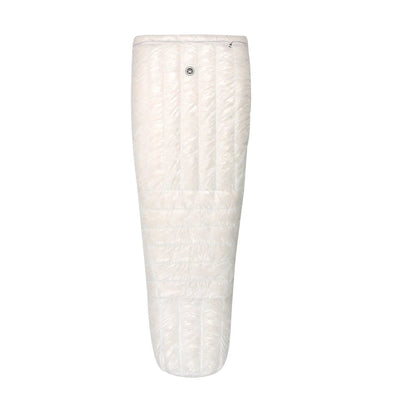
Unlike a classic 0-degree sleeping bag, this quilt relies on straps that secure it directly to the sleeping pad, shifting the responsibility of ground insulation to this piece of equipment rather than the back insulation, which is removed on this model.
10D fabric: the weight versus handling trade-off
The 10D IFlex fabric, thinner than standard 20D nylons, requires careful handling during setup and packing, a direct trade-off for the weight savings sought in this ultralight sleeping bag.
If the Quilt format seems too minimalist and you prefer the full enclosure of a traditional hooded sleeping bag to face the same temperatures, the Blacksnow 0 degree profile will be an excellent alternative.


Why pay more for the same performance?
The Aegismax Wind Hard Twilight was compared with the Decathlon Sprint. The finding is simple: you get equivalent technical features and warmth without paying the brand premium. Keep your budget for your next expedition.

Data checked against the brands' official product pages — subject to change.

Doubt about which bag is right for you?
The field guide helps you choose based on skill level, temperature, needs, and weight. Support answers specific questions.
Find my bag Contact supportFrequently Asked Questions
The Aegismax Wind Hard Twilight has a comfort temperature of 0°C and a lower limit temperature of -5°C, measured to the EN 13537 standard. These values apply under standard conditions: sleeper in thermal base layers, on an insulated sleeping mat. It is designed for hiking, bivouacking use (3 seasons).
The Aegismax Wind Hard Twilight is filled with 800 fill power, RDS certified. The Aegismax Wind Hard Twilight weighs 509 g, which places it in the ultralight category.
The lower limit temperature is the lowest temperature at which a reference man can maintain his body heat curled up, according to EN 13537 / ISO 23537-1. It does not correspond to comfortable use: below the limit temperature, the sleeper is likely to suffer from the cold. For real use, the comfort temperature is the main reference.
The minimum recommended temperature is the bag's comfort temperature, measured to EN 13537 / ISO 23537-1. For a 0°C bag, this means a standard sleeper can spend a night without feeling cold at 0°C, provided they use an insulated sleeping mat (minimum R-value of 2 to 3) and wear thermal base layers.
For extreme cold (below -10°C), the most suitable bags combine high-loft down (700 cuin minimum, ideally 800 cuin and above) with a mummy cut that limits heat loss. A sleeping mat with an R-value of at least 4 is essential alongside. For nights between 0°C and -5°C, a good-quality 3-season bag with a 0°C comfort rating is generally sufficient.