


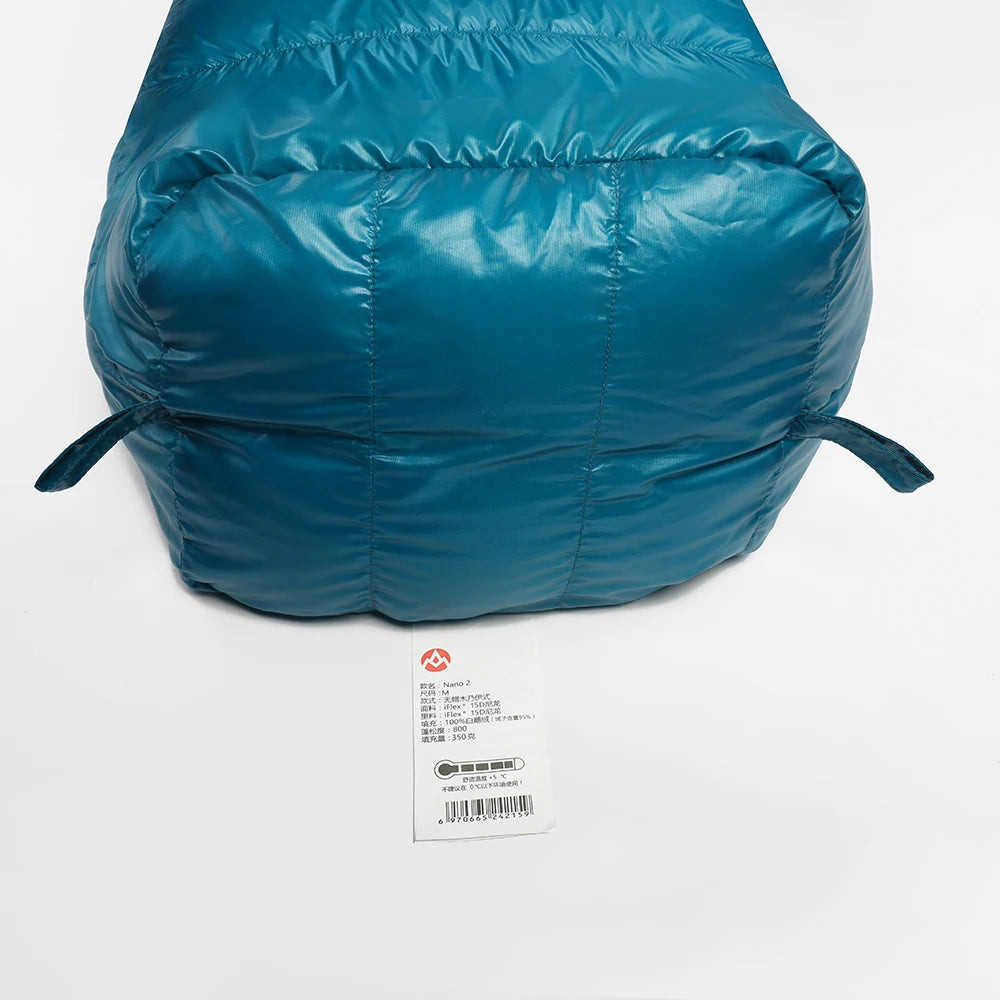
Ultralight 800FP down mummy sleeping bag for bivouacking and trekking

IFlex 15D DWR fabric: lightweight and resistant to light moisture
Self-sealing vent and 3D footbox: regulation without opening the zip
The self-sealing vent allows excess heat to escape without opening the main zipper, which is useful in a bivouac sleeping bag where every opening lets accumulated warm air escape. The 3D footbox adapts to the shape of the foot without compressing the down in that area.
Splicable versions: an adaptable trekking sleeping bag
The Regular and Lengthen versions can be joined together to form a double sleeping bag, a rare flexibility for such a minimalist trekking sleeping bag.
If you need an integrated hood and an extended temperature range to 7°C, the Aegismax Leto adds these features for 642g in Regular with the same goose down filling.



Doubt about which bag is right for you?
The field guide helps you choose based on skill level, temperature, needs, and weight. Support answers specific questions.
Find my bag Contact supportFrequently Asked Questions
The Aegismax NANO 2 has a comfort temperature of 5°C and a lower limit temperature of 0°C, measured to the EN 13537 standard. These values apply under standard conditions: sleeper in thermal base layers, on an insulated sleeping mat. It is designed for trekking use (Summer).
The Aegismax NANO 2 is filled with 800, RDS certified. The Aegismax NANO 2 weighs 624 g, which places it in the ultralight category.
A down sleeping bag is insulated with goose or duck down and feathers, whereas a synthetic bag uses polyester fibres. Down offers a better warmth-to-weight ratio and packs smaller than synthetic insulation of equivalent warmth; synthetic keeps more of its insulation when damp.
A well-maintained down sleeping bag retains 80 to 90% of its insulating properties after 5 to 10 years of regular use. The main cause of degradation is long-term compressed storage, which gradually breaks the down clusters. Washing once a year with a down-specific detergent and storing the bag uncompressed out of season significantly extend the life of the fill.
The ideal comfort rating depends on intended use. For summer trekking in France (Alps, Pyrenees, GR20), a comfort temperature between 0°C and +3°C covers almost all situations. For static summer camping in the lowlands, +5°C to +10°C is enough. For extreme cold or winter wild camping in the mountains, aim for -10°C comfort minimum. The comfort temperature is always measured to EN 13537 / ISO 23537-1 / GB/T 38426.