


5-degree sleeping bag: comfort 5°C and limit 0°C for a first bivouac
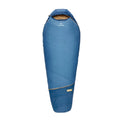
First bivouac, tight budget, spring or summer outing with nights around 8°C: the Naturehike MG120 is a 5-degree synthetic sleeping bag weighing 670 g in size M. Its comfort rating of 5°C is the temperature at which you sleep comfortably, with an insulated sleeping pad and long underwear. The limit temperature of 0°C provides a safety margin if the night is cooler than expected.

Synthetic or down for a hiking sleeping bag: how moisture changes the night
The question that comes up before a first purchase: down or synthetic? When you wake up, the tent is dripping with condensation, the grass is soaked with dew, and an unprotected sleeping bag becomes one more worry. The Sundounce Gold-Label fill (60 g/m², double layer, 359 g in size M) is synthetic: it handles moisture better than untreated down, which provides peace of mind for learning without the stress.

Open-top cooler bag: get out after 3 hours without losing all the cold from the bag
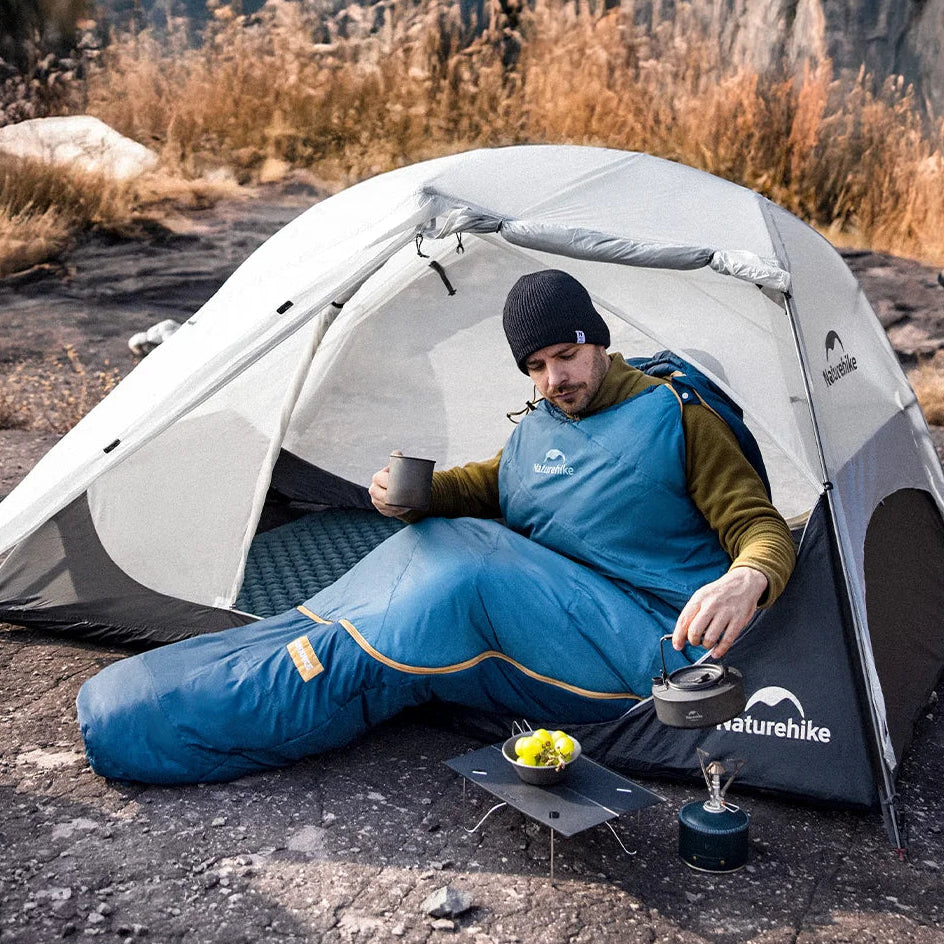
Need to step out of the sleeping bag in the middle of the night? The instinct is to unzip everything, but the accumulated warmth escapes in seconds, making it hard to drift back to sleep. The foot box can be unzipped independently: your feet can poke out while the rest of your body stays warm. It is insulated so that your toes won't be the weak point, and the two-way YKK zipper lets you ventilate from the bottom when the night is milder than expected.
Compact sleeping bag measuring 18 × 15 × 30 cm: a sound purchase, made from GRS-certified recycled fabric and free from PFCs
Volume matters as much as weight when your backpack is already full. Compressed, this compact sleeping bag measures 18 × 15 × 30 cm in size M (19 × 16 × 32 cm in L, 19 × 16 × 34 cm in XL). The 20D 380T ripstop nylon outer fabric is made from GRS-certified recycled yarns, with a PFC-free water-repellent treatment (report ETK-00042501-MUL-2508) and GB 18401-2010 Class A certification, the strictest class of the Chinese textile safety standard. The liner is stated to be antibacterial and anti-mite, with over 90% antibacterial effectiveness.
For itineraries in dry conditions where weight is a priority, the Aegismax Leto offers +7°C comfort at 642 g with 700 fill power down insulation.



Doubt about which bag is right for you?
The field guide helps you choose based on skill level, temperature, needs, and weight. Support answers specific questions.
Find my bag Contact supportFrequently Asked Questions
The Naturehike MG120 has a comfort temperature of 5°C and a lower limit temperature of 0°C, measured to the ISO 23537 / GB/T 38426-2019 standard. These values apply under standard conditions: sleeper in thermal base layers, on an insulated sleeping mat. It is designed for Trekking, bivouacking use (3 seasons).
The Naturehike MG120 is filled with Sundounce Gold-Label Synthetic 60 g/m² double layer (359 g in M). Synthetic insulation keeps insulating when damp, dries quickly and needs no special care — suited to changeable conditions or family trips. The Naturehike MG120 weighs 670 g, which places it in the ultralight category.
A 3-season sleeping bag is designed for spring, summer and autumn. Its comfort temperature sits between 0°C and +5°C, which covers most wild camps in France up to 2,500 m outside winter conditions. In winter or above 2,500 m, a dedicated cold-weather bag is needed.
A 3-season bag is suited to night-time temperatures between roughly 0°C and +15°C. Below 0°C, thermal comfort is no longer assured without extra equipment (liner, additional sleepwear). Above +15°C, most sleepers will find the bag too warm: venting through the foot zip helps regulate.
For the vast majority of walkers and trekkers in France (GR20, GR5, Tour du Mont Blanc from June to September), a 3-season bag with a 0°C comfort rating is sufficient. A 4-season bag is only needed above 3,000 m outside summer, in winter conditions, or for exposed high-altitude wild camps in autumn.